The Maps We Burned
There is a distinct kind of modern exhaustion that doesn’t come from working too hard. It comes from wandering.
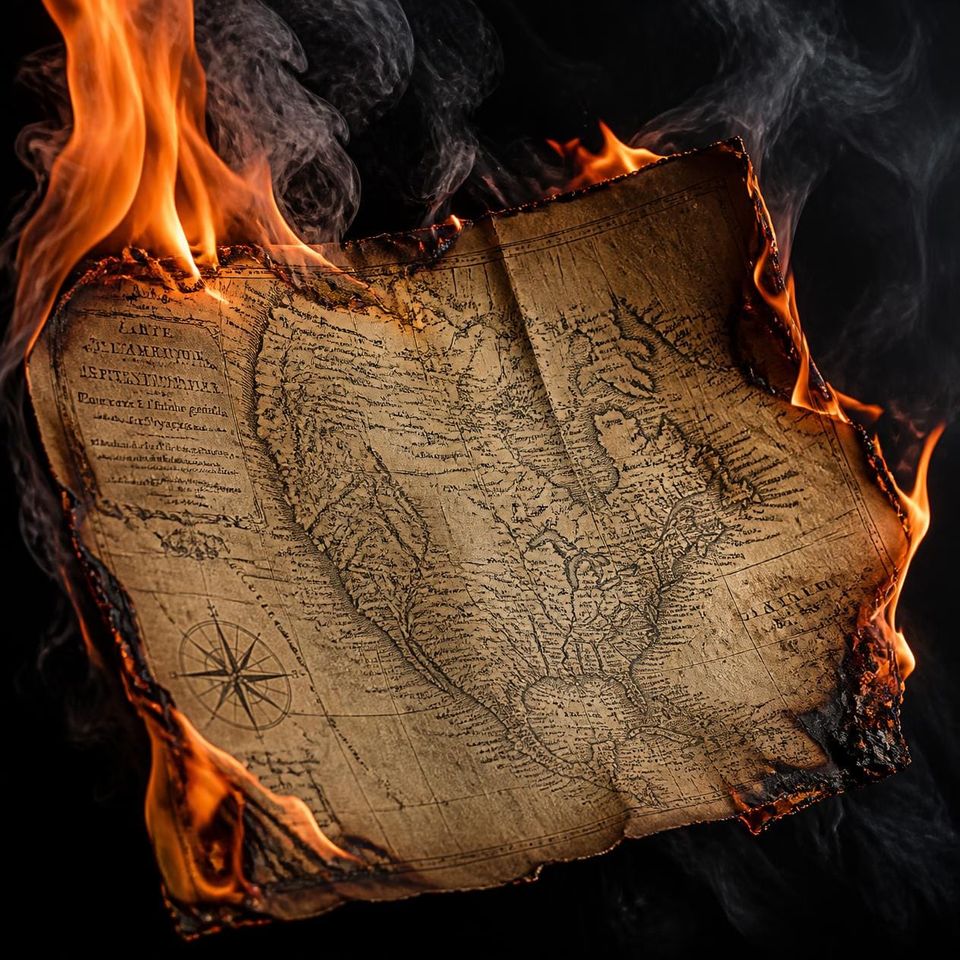
I hear it in your letters every week—this quiet, persistent aching to make sense of things. We feel lost, like travelers who walked far beyond the perimeter of where we began, only to realize we left the maps behind.
For thousands of years, our trajectory felt tangible. We moved from the intimate circle of hunter-gatherer campfires to the rhythmic, rooted life of agriculture. Eventually, we built the engines of the Industrial Age, a time hailed as the absolute peak of human achievement and ingenuity. And now, here we are: standing in the vast, hyper-connected void of the Information Age.
We’ve been told a very specific story about this moment. We are told that humanity is on an inevitable march ever onward toward a lofty, as-yet-unknowable future. The narrative promises that if we just keep innovating, keep optimizing, and keep progressing, we will eventually stumble into that long-sought utopia—the one we’ve been searching for ever since we first stepped out of the campfire's glow and into the dark.
But is that really what’s happening? Or have we just been walking in circles while the ground beneath us shifts?
The Cost of the Endless March
In our relentless pursuit of meaning through progress, we have quietly let go of the very things that once anchored us.
We traded local reliance for globalization, and in doing so, we severed the threads of immediate community. I no longer know the hands that made my socks; they arrive from another part of the world. I no longer know who rendered the soap I use; it is manufactured on distant, unseen shores.
Along with this shift, our rich, varied cultural stories have been distilled down into frictionless, universal algorithms. The deep, localized narratives—the ones that told us who we were as individuals, who we were as a people, and where we might go together—have been diluted.
The result of this distillation is a profound cultural amnesia. We have forgotten the basic mechanics of human connection: how to relate to one another, how to hold deep respect across differences, and how to honor the unique textures of our varied backgrounds without needing to flatten them out.
We have gained the whole world’s data, but we’ve forgotten how to speak to our neighbors.
The Final Boundary
Yet, among all the things we’ve forgotten, perhaps the most profound loss is our understanding of what happens when the story ends.
Death is a curious phenomenon, isn't it?
For centuries, Western culture treated death as a single, absolute event—a sharp line drawn between the living and the gone. But modern science is beginning to catch up with a truth that feels far more intricate. As Dr. Sam Parnia, a leading resuscitation researcher, notes:
"Death is not a moment in time, but a process—a process that can be interrupted, delayed, or even reversed."
If death is not an abrupt wall, but a process, it forces us to ask a fundamental question: What is the outcome?
After all, every process in nature leads somewhere. The purpose of any process is to create an outcome suitable to the problem it was designed to solve. So if death is the mechanism, what is it trying to accomplish?
This is the central question we have lost the vocabulary to answer. In all our cultural forgetting, we have treated biomechanical death as an event horizon—a terrifying void of total annihilation.
We forgot that it is a doorway.
Shedding the Weight
A doorway is not an ending; it is a transition space. It is the threshold through which we shed everything that no longer serves us, stripping away the heavy, temporary gear of physical existence to adopt whatever is necessary for what lies beyond.
And what lies beyond that threshold? That, it seems, is wholly dependent upon us. It relies on the consciousness we cultivate here, the meaning we dare to build in the dark, and our willingness to remember who we were before we lost our way.
We don't need a grand, global utopia to stop feeling lost. We just need to stop running long enough to look at the doorway right in front of us—and start remembering how to carry each other through.