Tending Forests We Will Never Walk: Cathedral Thinking in an Age of Anxiety
We live in a culture that treats death not as an inevitability, but as a design flaw. We push it to the margins of our awareness, offloading its physical realities to sterile rooms and a multi-billion dollar end-of-life industry built around the quiet promise of denial. In his landmark work The Denial of Death, Ernest Becker argued that much of human activity is an elaborate defense mechanism—an effort to build monuments to ourselves so we might pretend our clock isn’t ticking down.
But when fear shrinks our vision to the span of our own few decades, our choices shrink with it. We begin to act like short-term tenants rather than long-term stewards, paralyzed by the boundary of our own mortality.
What if the antidote to our existential anxiety isn't to outrun death, but to look past it? What if the most liberating question we can ask is not How do I preserve myself?, but What am I building that I will never live to see finished?
The Foundations We Lay in the Dark
To look past the perimeter of our own lifespan, we have to reclaim an intellectual and spiritual posture that modern culture has largely forgotten: cathedral thinking.
At its core, cathedral thinking is the practice of conceiving, planning, and executing work designed to outlast the person who initiated it. It is the deliberate commitment to projects whose completion date lies far beyond the boundary of your own mortality.
The phrase draws its origin from the master masons, quarry workers, and artisans of the High Middle Ages. When the foundations of places like Chartres, Notre-Dame, or Cologne were laid, everyone involved—from the architect drafting the geometry to the laborer cutting the stone—knew a simple, unyielding truth: they would never see the finished structure.
The person who dug the footings would not stand under the vaulted ceiling. The carver shaping a gargoyle would never watch light filter through the completed stained glass. They were working for a community they would never meet, under a roof they would never sit beneath.
In a modern world addicted to immediate feedback loops, quarterly returns, and the short-lived dopamine of instant consumption, cathedral thinking feels almost radical. It forces us to shift our fundamental orientation from ownership to stewardship. It asks us to abandon the ego’s demand to witness the harvest, requiring instead that we take quiet pride in the act of planting.
When we adopt this mindset, our relationship with our own expiration date changes. Death is no longer a abrupt wall that renders all our efforts meaningless; it becomes a natural handoff. The boundary of a single lifetime ceases to be a limitation, becoming instead the precise measure of our contribution to a much longer, collective draft.
Tending the Forest We Will Never Walk
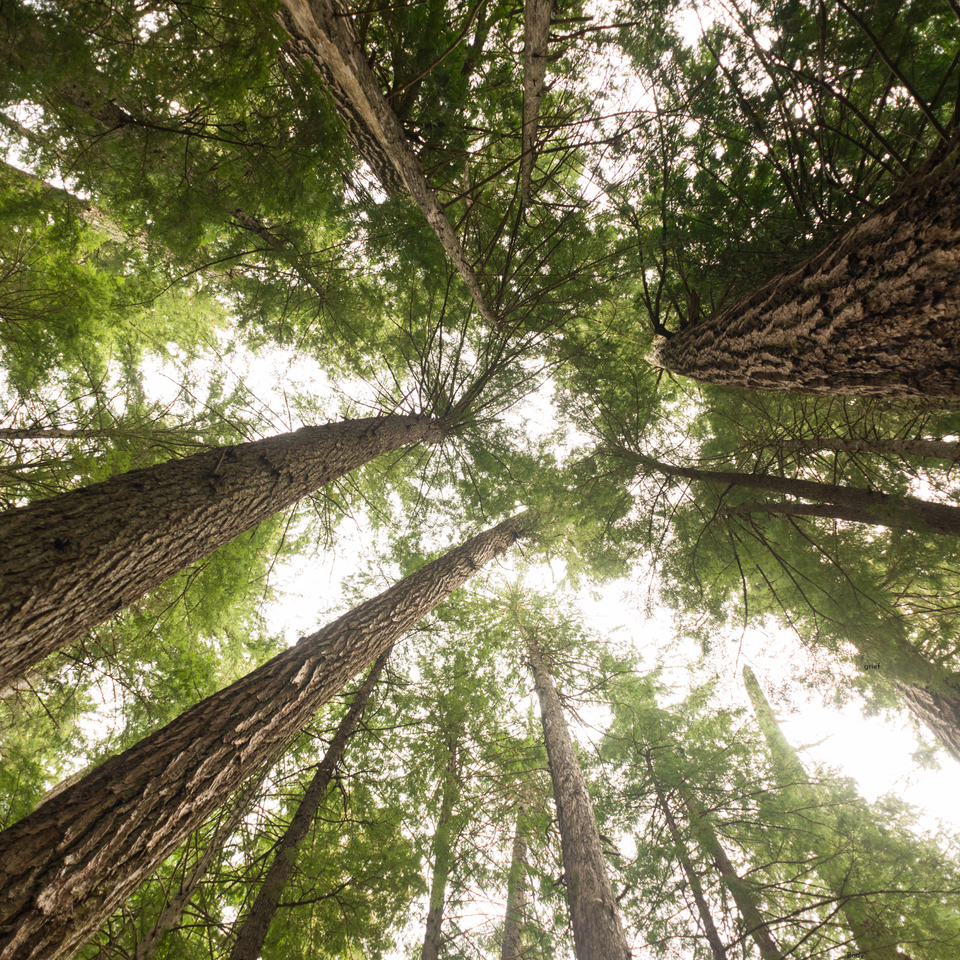
When we apply cathedral thinking to the living world, the metaphor shifts from stone and mortar to soil and seed. A cathedral built of oak, topsoil, and aquifer carries an even higher stakes mandate than one built of limestone: unlike stone, living systems require continuous, intergenerational care, adapting to conditions the initial planner could never fully predict.
Today, our ecological crises are largely the byproduct of temporal myopia. When we view the Earth through the narrow keyhole of a single lifespan—or worse, a single fiscal quarter—we treat living ecosystems as extractive capital. Forests are cleared for immediate yield; soil is mined rather than cultivated; water tables are depleted to satisfy present demand. Fear of our own finitude creates a frantic urgency to consume, control, and extract everything we can before our time runs out.
Planetary stewardship demands that we slow our pulse to match the metabolism of the land.
To re-wild a degraded landscape, to rebuild depleted topsoil, or to establish a resilient forest canopy is, by definition, a cathedral project. Consider the planting of an oak savanna or the restoration of a river basin. The person who clears the invasive brush and protects the first fragile saplings will likely only ever see a field of spindly whips. They will not live to hear the full chorus of migratory birds returning to the mature canopy, nor will they sit in the deep, sprawling shade of a two-hundred-year-old white oak.
Yet, in doing this work, our relationship to our own mortality undergoes a profound quietude. The anxiety of personal extinction begins to dissolve when we recognize that our short decades are woven into a vast, ongoing ecological lineage. We are not isolated actors stranded in time; we are the descendants of those who tended the soil before us, and the ancestors of those who will walk the woods we plant today.
To engage in long-term ecological restoration is to offer a quiet, courageous answer to the silence of death. It is an affirmation that the world matters beyond our presence in it—and that the highest form of love we can offer the future is to leave behind foundations strong enough for life to keep building upon long after we are gone.
The Work Beyond the Horizon
Ultimately, facing death is not an exercise in despair, but an invitation to step into a wider room.
When we dismantle the cultural taboo surrounding our mortality—when we refuse to hide behind sanitized industries and short-term illusions—we free ourselves to ask the only question that truly matters: What are we doing with our fleeting turn in the light?
Cathedral thinking offers us a way to make peace with our expiration date. It reminds us that our purpose was never to see the final stone set in place, nor to harvest every fruit from the orchard we plant. Our purpose is simply to take up the chisel, to clear the brush, and to pass the tools faithfully to the hands that come after us.
When we plant trees whose shade we will never enjoy, when we mend soil that will nourish children we will never name, death loses its power to paralyze us. The boundary of a single life ceases to feel like a tragic limitation and becomes, instead, a quiet, sacred boundaries within which we offer our best work.
Our biomechanical suits have a finite, fixed expiration date. But by choosing to live as good ancestors—by building, tending, and loving far beyond the edge of our own horizons—we ensure that when our personal story ends, the cathedral endures.